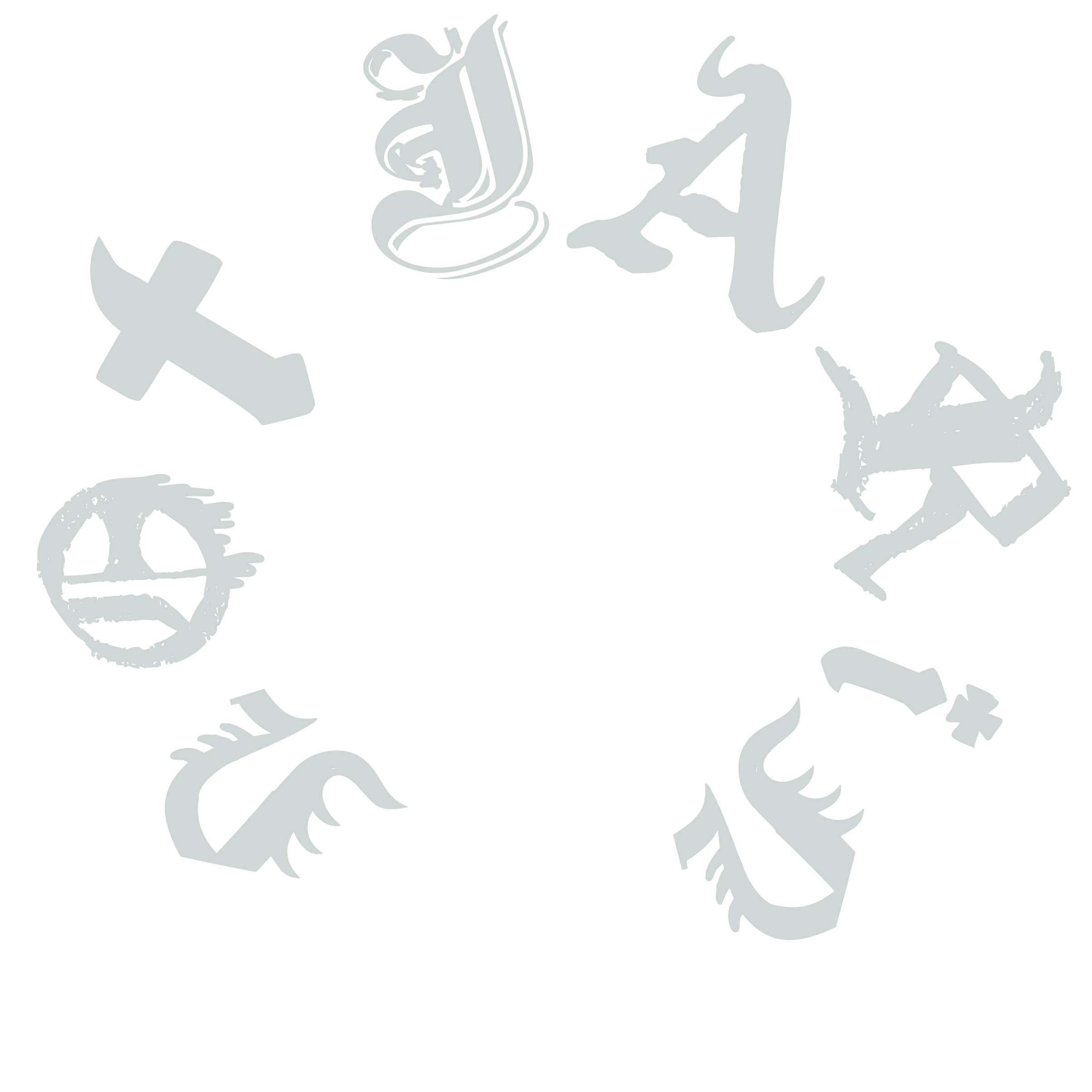
There are two main interests I explore here.
I became interested in type design while working on my thesis in grad school. I did not come from a design backgkround. Like many grad students, I was trying to understand and define my practice all at once. This led me to the conclusion that type is the soul of graphic design. Grids and information can also be used by architects and engineers. Type is what sets graphic design apart. I don't know how many designers would agree, or maybe everyone already knew this, but this is primary interest 1.
Interest 2 comes from painting. I studied painting as an undergraduate, and for a time, was devoted to being a painter. My focus was a sort of narrative abstraction. There exists a method of zooming in so closely to something that it becomes abstract, and we could attempt to find form within that zoomed in image. When painting, I had a mission of implying balance through these vague forms. This process, I think, lends itself to the design of letterforms as well.
These are my explorations and my attempts to both define and discover the solely artistic side of my practice, which is now driven by graphic design and the web. Fonts merge all of these things.
My graduate school thesis was called NotDef, named after the symbol that appears in software when a character is not detected in a font. This is what I wrote about it, lightly edited.
Designing a letterform can feel like creating a scientific specimen, a carefully studied sample whose makeup can be crafted and then adapted for use in other characters. The process of designing a typeface is a balance between gesture, intuition, and math. It can produce an abomination, something functional and beautiful, or, perhaps more interestingly, something in between.
NotDef is a collection of typefaces conceived from a formal prompt (gradients, Fraktur terminals, ultra-heavy type, slender counters) and then developed through a combination of that formal prompt and particular cultural references and connotations (corporate nametags, Hōkūleʻa, non-humanoid aliens, Urag gro-Shub the Arcanaeum librarian from Skyrim). Those references and connotations are used to imagine a world within which each typeface exists. The type’s design then defines and expands upon the rules and characteristics of that world, emulating the way we can construe the qualities of a genus by studying the qualities of its individual members. This project investigates the ways in which type design might balance legibility and surprise to create ambiance, which can be modified by changing contexts, creating imagined worlds, and shifting materiality. Drawn letterforms demonstrate the execution of a range of expression, expanding upon the elicited feelings that are possible through careful attention to gesture and form.
The installation of this project consists of 400 feet of extension cable feeding life into the presentation of the letterforms. An animation is playing on a personal TV from the 1980s, the age of Cyberpunk, a literary genre turned cultural phenomenon that blurred the lines between our human reality and existence through machines.
“While science fiction frequently problematizes the oppositions between the natural and the artificial, the human and the machine, it generally sustains them in such a way that the human remains securely ensconced in its privileged place at the center of things. Cyberpunk, however, is the breakdown of those oppositions
“While science fiction frequently problematizes the oppositions between the natural and the artificial, the human and the machine, it generally sustains them in such a way that the human remains securely ensconced in its privileged place at the center of things. Cyberpunk, however, is the breakdown of those oppositions.”
- Veronica Hollinger (1990)
Creating ambiance and emotion, which are innately human, through an inherently technological method of digital type design and font engineering is akin to birthing a monster such as Frankenstein’s of formal decisions in the hopes of generating new life through digitally rendered letterforms. The variation in materiality of the installation references LAN parties, internet cafés, and the portrayal of hacker-culture in pop-culture; it also alludes to each font having visual systems and expressions that are distinct from one another. The choice to use these visual references also refers to portrayals of lifeforms that are created from the integration of anthropomorphic bodies and technology. In The Matrix, for instance, the crew of the Nebuchadnezzar are plugged into the simulated reality of the Matrix via the means of an intrusive, nearly surgical machine-body interaction. Similarly, when they are initially awoken from their state of artifice in the Matrix, their bodies are decoupled from various mechanical tubes, and they arise out of a viscous liquid as they see the real world for the first time.
“If you are looking for the true avant-garde of typography, I would not recommend traveling to your favorite foundry, or to the portfolio site of a recent graduate from KABK, but instead to a little website called Dafont.com. The most expressive typographical excursions can be discovered here, a place where legibility is pushed to the brink and corporate logo bootlegs run free. This isn’t to say that there aren’t hideous crimes lurking on the website […] but there are real moments of beauty and expression that exist well outside the boundaries of rules and taste […] it’s low bar for entry has allowed for typographic expression to flourish on the web.”
– Erik Carter (2024)
© 2026 Jarin Moriguchi